Thursday, 19 February 2015

Dogs and happiness

I'm not here to talk about soul-fulfilling, enduring, long term happiness. That needs a lot more than a dog (or maybe, a lot less than a dog, given that it probably comes from inside of you and is at least partly a decision). I'm here to talk about that wonderful pick-me-up that you can get from spending time interacting with a dog.

No nonsense here, this is a scientifically studied phenomenon. Those same feelings you got when you are newly in love? A dog is a perpetual source of those. Simply sitting with your dog and gazing into their eyes has your body making lovely bunches of the stuff, but even better than that, your dog typically likes to move and be active, so if you have a dog, you are much more likely to move and be active ... and it's no secret that regular exercise is pretty essential to keeping a positive outlook on life. Elle from legally blonde had it right:
" Exercise gives you endorphins. Endorphins make you happy. Happy people just don't shoot their husbands, they just don't."
So, having a dog makes you happy. This is starting to sound like a "get a puppy" commercial (or an adopt a dog pamphlet, which might be even better if your main aim is a happiness provider). Might I mention that dogs reduce the risk of heart disease massively too?

Heh. Not really what I want to write about. Nor is an 'adopt a dog' message what I want to get at (dog ownership is a lot of work too, so never just impulsively get one).  What I actually want to write about is the specific things that my dogs and I get up to that makes me happy. There are three of them, physical touch, activities, and play.

1. Physical touch

My little pug, Talos, is a great source of physical touch and comfort to me. She's not a touchy-feely dog by any measure, she rarely stands still for petting and even more rarely enjoys it (a quick wrinkle rub is enjoyable, but that's about it). What she does do, though, is put herself on my lap and just stays there, napping, watching TV, or my computer screen, or just the world going by. She's done this since she was absolutely tiny.

Dis is my lap. Yoo mus go find other one.
She also cuddles while we sleep. Carding my fingers through her soft, soft fur is one of my day's great pleasures. She has a sense of when you're feeling less than wonderful too, and then, she makes extra effort to be near you.


2. Activities

Let's go do stuff! Both my dogs like getting out there and doing stuff. Be it tracking, or just a walk around the neighbourhood, they're almost always ready to go. If I'm feeling particularly low, taking them to a park with other humans and other dogs almost guarantees positive, pleasant human and canine interaction. I simply cannot feel sad while amusing children with your pets' antics (one having her belly rubbed, the other coaxing them into a game of chase or doing tricks for them). Getting your pooch and going to a class has much the same effect for me. We go, we work towards a goal with other people, and like magic your internal happiness tank is a little fuller.

Some days when I just don't want to see other people, getting out into nature makes a big difference too. If your dogs are reasonably healthy and willing to come back when you call, try a short nature hike (if their recall is less great, do the same but with a long line...). It is both really nice to just get out, and to watch your dogs just being dogs without the pressure to behave that is sometimes present around a house or in daily life. Plus, it's pretty!

So very, very pretty!

3. Play

This is the big one. Here's a challenge for you. Be sad. Very, very sad. Then look at these:


Is dere something in mah jowl?
Er mer ribbon!
No one can resist my play!
CRRRAZY EYES!

Feel better? Not yet? Have some more!


Now? Excellent. Go play with your dog :)

Basically, one of the key parts of my happiness is my dogs. I'd bet they do the same for you, if you'd let them.

On friendship and love (and Valentine's day)


Tell me now,
happy Valentines
why all your florid praise
and erudite verses 
somehow fail to wow? 

Could it be that love 
or friendship 
is not a summer's day 
or a red, red rose 
or the cooing of a dove? 

No, to me it would seem 
love is nothing less 
or more 
than two curls mirrored 
in black and cream

Sunday, 18 January 2015

Things you may not have tried - Tracking


On Saturday mornings, at 5:30, three normally markedly more nocturnal creatures rise from their slumber, and head for a congregation of like minded people in one field or another. 

Mornings are simply the most beautiful part of a day. The world is fresh and new, seemingly sparkling with delight in the soft sunshine. 


But we are not out here to admire the beautiful morning, no. Well, not entirely. We are here to plant a pole in the ground, and armed with a chunk of raw animal, walk away from that pole in strange patterns, carefully counting out steps as we go. 

Look carefully, and you can spot the human walking in a straight line away from the pole, laying a track.
Tip: She's in front of the mine dump.
At the end of your particular pattern, which, for those just starting out is a straight line, but for those quite advanced can be an 'R' shape, an 'h' shape, or even the infamous 'B', you commit your chunk of animal to the care of the grassy field, step over it, and carefully walk back to where the cars are parked and the dogs are waiting eagerly. Beginner dogs will set out nearly straight away, but more experienced dogs can wait for a long time, sometimes several hours, or even a day, before they are asked to follow their track.

Kira is not one for overt shows of excitement. Sure, she likes treats, and she loves belly rubs, but aside from the most wonderful dance for her daily walk and the occasional bone, she maintains an air of stoic dignity. Not so at the tracking fields. Impatiently she barks at you from her crate as soon as she becomes aware of your approach. She can barely stand still for her harness to come on, can barely contain herself as you clip the ten meter long line to it. 

C'mon Nina!
Impatiently she jumps up at me, prompting me to get to the starting pole faster, faster.

When we reach the pole, magic happens. You approach the pole you planted and touched, and Kira changes. Her whole self awareness shrinks down to her nose, and after what seems like the briefest of sniffs at the base of the pole, we're off. I let the line play out until she's about seven meters away from me, enough distance to let her work on her own, but close enough that I am there, performing my duty of marking the last known point where she was correctly on the track. Mine are small dogs, Kira nearly disappears into the summer grass.

#smalldogproblems
Following an invisible path through a field, one consisting of your scent only, that your human eyes cannot see, that you have only the barest of remembrance of exactly where you stepped, is a humbling experience. Kira tracks well over 300 meters, and while I definitely have the general gist of where I went, she can tell me where I stepped and how long I lingered there. Halfway along, her track veers sharply to the right - we are teaching her to do corners, is the official reason. This seems absurd, though, when Kira takes the corner without stopping, without hesitation. She just smoothly turns right and continues. Teach her this, this skill that is as basic to her as breathing? We are fooling ourselves. 
Om nom nom!

Of course, this whole adventure is hardly humbling for Kira, who delights in forging ahead at great speed, occasionally looking back with a grin as if to laugh at me and my inadequate senses. 

Sooner than you think, Kira is upon her prize, and while I sing her praises she eats it.

Where Kira is just amazing at tracking, unstoppable, unflappable, and with a confidence and accuracy that belies her short career, Talos is not. Compared to Kira, to me, Talos seems downright slow, but in all fairness, she is about average at this tracking game. Slow, methodical, and insisting upon dead silence while she works, where Kira could not care less if you were to pull out a marching band and dance a can-can, as long as you walk faster, already. 


Talos also nearly disappears into the lushness of summer.


Talos tracks a hundred meters, despite having been at this for much longer. But I am proud of every step, because malicious rumour has it that pugs cannot do this. I can truthfully say rumour is false, that while Talos is average, she is as good as any other average dog. I am quite sure there are pugs that are better at this, with more focus for this kind of task, as I am quite sure that there are fairy-headed basset hounds that will be quite inept, though I suspect both cases are about equally rare. Either way, learning independent working, and learning to both use, and trust their nose, is a great skill we must encourage in our dogs - most especially those who tend to ignore it!

Good pug. That will most definitely do.
This does not take away from the fact that my little pug sniffs her starter pole, and sets out on her invisible path into the field, leading me to the prize. We are developing her confidence, as you can see, we crossed a footpath this morning - difficult for many dogs, they tend to follow along the path in stead of sniffing out the fainter scent of their own human leading back into the brush. But no problems here, slowly, carefully my puggy lady sniffed my trail, and slowly, carefully she sniffed the path, before moving right over it and back into the tall grass.

Hers was a very well earned reward at the end, today.


Talos is never one to let an opportunity to have fun pass her by. 

Afterwards, what would a good morning be without some frolicking in the grass?
At tracking, the silly side of Kira comes out, and she happily bounds through the tall grass, chasing fairies that only she can see. Undoubtedly the star of the morning, her normally reserved self just can't help it. Whee!


With this in mind, do consider giving tracking a go. Unlike many dog sports, you need next to no equipment, and while handling a long line and learning to read your dog's body language take a bit of finesse, both are easily learnt with a bit of practice. 

You will need a long line, which is quickly made out of some rope and a clip, a harness, which you likely have already, and a chunk of meat from the butchery. These are easy and useful things to have anyway, and while you can often borrow one, the pole is little more than a broomstick with a spike on one end. In our experience, the trainers gently, slowly, encouragingly coax your dog over time - you cannot force a dog to track.

The activity is suitable even for physically less strong dogs, like Talos, they merely need to be able to move forwards (though, if like my two, you will track through tall grass, some fitness may be required for them to keep bunny hopping for 300 meters, like Kira tries to do). 

It's really hard work for the dogs, despite the relatively physically undemanding nature. Both of them sag down into their crates when we head home afterwards and are completely out for the whole drive and for most of the rest of the day. Well earned sleep, I say!

To recap, the good and bad of tracking:

Good:
The sheer magic of 'seeing' through a dog's nose
Really easy to get started
Little to no equipment needed
Physically relatively undemanding for both dog and human - both must be able to walk for moderate distances
Encourages independent thought and confidence in a dog
Safe even for dog/human reactive dogs - dogs are on lead, and widely spaced in a large area

Bad:
Early mornings
Involves some travel to get to large open spaces
Can be very slow paced
Lots of exposure to ticks

Monday, 5 January 2015

Dating site profile: Bane (or, am I your dog?)

Introducing Bane, a sleek, glossy black boy with so much love to give.

Am I your dog? 
Bane is two years old, male, neutered and has gorgeous brown eyes with short, black fur with a white patch on his chin, chest and tiny bit of white on his toes. He weighs about 40 kilograms.

Bane is everything you could want in a big, bouncy dog. He loves to swim and he loves to play games. He would love long walks and play sessions in the park, but sadly, right now, he can't get those. Bane and his house mate, a female dog, do not get on very well, and with only one human between them there simply is not enough time or energy to give both dogs what they need.

Bane is very, very excited about new doggy friends, so much so that his enthusiasm can be a bit scary to other dogs, landing him in trouble. Taking a bit of time to slowly introduce him to many friends should help with this, though - he's not a bad boy, just a bouncy boy!

Bounce is not all this hunky hound has to offer. He is a champion cuddler, and would like nothing more than to curl up with you and watch a movie or a game. Even better if you would share your popcorn - that's right, this boy loves treats!

Bane has been very well cared for, he has all of his vaccines and has been regularly seen by a good vet. He has eaten only good quality dog food. He lives in Johannesburg, but he can easily get to anywhere within an hour or two's drive.

Could this be just the dog you were looking for? Comment below, drop me an email, send a smoke signal... This boy needs a home!


Thursday, 27 November 2014

Hiking with dogs - some important stuff to think about

I love taking my dogs and going for a hike. It's unlike a walk in two ways, it usually allows me to let them run off lead, and it is often 'out in nature' as much as I can get in a big city. I imagine that many people would enjoy this, and I always encourage people to get out there and walk more often, especially with dogs in tow. They need more exercise than we think, and more mental stimulation too, and a good hike meets both of those demands.

Plus, you get to take wonderful pictures.

Isn't she just beautiful? It was a cloudy day, that one, which makes for the most marvelous soft light.

I digress.

Picking up a lead and a collar, some poopie bags, and heading off on a neigbourhood walk is easy. There's very little preparation to be done. A hike, however, needs a little more thought. Let's look at some of those things:

1. Good dog kit.
A collar is mostly ok for neighbourhood walks, given that your dog is not much of a puller or not a type of dog susceptible to tracheal collapse. For a hike, though, you may need to hoist your dog bodily up a cliff, rapidly pick them up out of harm's way, or rescue them from a river. A good harness, one that is study, lightweight and neither chafes nor interferes with your dog's natural movement is the way to go. The Julius K9 harnesses are really neat (Talos is wearing one in the picture above), having a handle and space for some doggie back packs, but any sturdy H-harness works well too, though they do tend to wear away some hair at the very base of their rib cage. I've found, for the terrain we tend to hike through, that fabric harnesses pick up too many burrs and seeds and get scratchy very quickly (poor dogs!). This may well differ in your area. I don't much like step-in harnesses, they tend to catch my dog in the armpit which affects their gait.
In the picture above, you can see my preferred hiking kit - collar and leather h-harness. Having clearly marked and readable tags on your dog is a very, very good idea, and forms part of what I would consider good dog kit.
In colder climates, good dog kit may extend to include a coat or booties. Even mid winter it's never cold enough to warrant clothing on a dog while active, so I know pretty much nothing about what makes good active cold weather gear.

2. Good human kit.
Don't underestimate the value of a good, comfortable backpack that has enough space for all your things (in my case, this would include my camera) and a little spare, in case you need to pop a dog in there. Well, if you have bigger dogs, maybe not that last one. Additionally, take some time to think about your leads. You will want something that does not cause rope burn if you end up walking with dogs on lead for hours (you just might). Leather or soft rope leads are best, in my experience. A good hat, and some good, comfortable hiking boots with proper ankle support are good ideas too!

3. A good emergency plan.
If something happens in the suburbs or on a city block, you have many people around you that could help, and often, veterinary care nearby too. If something happens on a hill somewhere, though, it's not so easy. This teeny tiny emergency kit is a super idea:
Be Prepared: A Tiny First Aid Kit for Hiking With Dogs
Another thing to think about is what you'll do if your dog is so badly injured it needs carrying. Mostly this won't be an issue, unless you have a 50 kilogram plus big dog, or are physically unable to carry a pet. Having a working phone and someone to call for help is a very good idea, as is knowing where you are (or, more relevant, how others can get to your location).

4. Enough water.
This is perhaps less of an issue if you hike in an area with abundant clean water sources to drink from. In SA, though, it's hot and it's dry, and what water is available is usually not drinkable. Pack enough water for you and your dogs. In my case, an hour's walk in hot weather on a dry, dusty hillside sees me carrying about three liters of water. Half of that will go to me, and half to the dogs, more or less. I have a light plastic bowl for them to drink out of - collapsible silicone bowls are awesome for drinking water.
As an aside, knowing the signs of impending heatstroke is a good idea too.


This here pug is too hot, and needs to cool down. Shade, and water both to drink and to wet her with is called for. Look at that tongue - the bright pink, cup-shaped tongue is the key.

5. Pest control.
Where we walk, we encounter lots of ticks. Where you walk, it might be mosquitoes bearing heartworm, or snails bearing bilharzia, or leeches. Either way, you need to be ready. I apply some bug repellant to my legs, and both my dogs are treated with a topical spot-on treatment every four weeks.

6. A good recall.
Perhaps that's phrasing it a bit lightly. A really, really solid recall that will not let you down when your dog sees a zebra or a fieldmouse over there and wants to go eat it, but is likely to get killed if they try. This is the dealbreaker of off-lead hiking, if your dog does not come back, you will be without your dog very quickly, and very few dogs could survive on their own in the wilderness.
So practice, practice, practice. :)

Now go! Explore the wild places with your pooches!

Monday, 24 November 2014

Treats: Bacon, liver and cheese, oh my!

I, Talos, do not aprove of this message. I
am not getting too many treats! Outrageous!
I train with treats. Especially when we're learning new things, or practicing something in a new location, or working on short behaviours, or practicing good manners near people, or... well, I train with treats a lot. There's pretty much always a something something in my pocket.

I also have teeny, tiny little dogs. Itty bitty pooches that both of them, really, really love food.

Here we have the crux of the matter. Treats are easy. Anything your dog likes is a good treat. My list is long and varied, for the one it's mostly meat, for the other, fruits, some veggies and cheese is definitely also there.

Also easy is making your treats tiny. It's necessary to have them teeny tiny, because it's so easy to feed a small dog into rotundness.

But even so, I've noticed a distinct softness about the waistline of my pug. She's up 500 grams from where she was.

We have been training a lot, mind you. But I need to be careful! 500 grams on her is a 10 % weight gain.

So, some ideas for ways to stretch your daily treat allowance:

1. Use their food for treats.
Easier said than done, sometimes, but this is the best way to get more training bang for less calories. You can absolutely cut kibble into smaller bits. If you feed a canned food or a minced raw, it's slightly less gross if you have the food a bit frozen. If you feed prey model raw... well, I guess you could still chop it up, but that kinda defeats the purpose?

2. Pick low calorie treats.
Sometimes this is bad - paper is low calorie, but is definitely not good for you. That said, there are great low calorie treat options. Bits of fresh apple, dried lung of any animal and carrot cubes are three low calorie suggestions that most dogs will like. Putting a tiny bit of 'bad stuff' into lots of low calorie stuff also works - a tiny bit of peanut butter in apple puree makes a tempting treat for dogs who don't like apple, but do like peanut butter (it even gets my two eating cucumber, which is pretty much water in terms of calories!).

3. Use different kinds of rewards.
Throwing a ball or offering a tug is a great alternative reward, building motivation and a relationship with you also. Plus, it's exercise, which your doggy can do with more of, I promise. The downside - not all dogs are toy motivated (not all are food motivated either, but then a discussion of treats is not relevant in the first place). You can build toy drive, but it takes time. It also takes time to reward with a toy. I can feed a treat a second (or more) during some training. You cannot play a game of fetch in that amount of time. So, this is great for rewarding behaviour chains, but not so good for rewarding a quick "101 things to do with a box".

4. Cut the treats even smaller.
If you're like me, then you prefer breakable treats that you tear pieces of as you go (chicken, both boiled or dried, is just super for this!). This means your treat sizes are already pretty small. But make an effort to give smaller treats, the reward is the same for your dog, and you are less likely to stray, like me, into feeding your dog too much.

Whatever you do, remember that treats are food too, and that it's all too easy to feed a tiny dog too much. Plan your treats like you plan their meals - weigh them, and know how much you give them.


Wednesday, 19 November 2014

Your dog is fat

I need to get something off my chest.

It's not something we like to talk about. But it's time.

Your dog, it's fat.


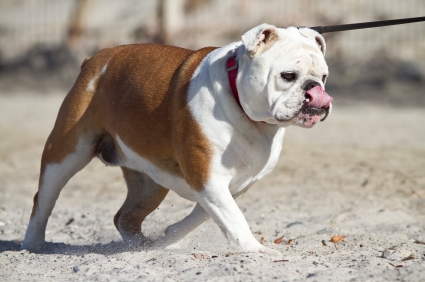
It's not 'just a Bulldog', if you cannot feel the ribs, if there is no waist and no tuck up from the side. It's fat. It can't breathe, it overheats faster... your dog is fat.


It's not a snuggly Labrador if it has a giant pocket of fat over its shoulders and in front by its chest. It puts strain on its joints, leading to faster hip degeneration and earlier old age problems. Your dog is fat.


It's not a cute Pug with puggy rolls if it is cylindrical. I don't care what the breed standard says, or what your expectations are. I don't care if the vet tells you your dog is healthy, trust me, they've either gotten used to seeing fat, fat, fat walk through their door so much so that they only really note horrible obesity, or they're too scared to tell you. Your dog is fat.

There's a secret behind all of this. You control all their food. Absolutely every bite that goes into that dog's mouth  -  it's on you. Your dog is fat... because you made it fat.

And the health problems that goes with a fat dog? It's on you too. Sore hips, faster arthritis, heart problems, overheating ... It's on you.

I'm sick of seeing dogs that are fat. Because it's on you. Because you're hurting your dog.

Food is not love. It's part of an expression of love, sure. But so much that you hurt them? That's not love.

I'll let you in on a secret - those images? I just googled 'bulldog', 'labrador' and 'pug'. No qualifier. These are what we think these dogs should look like. And you know what? They're all too fat.

Enough with this.

Put your hands on your dog. Can you feel their ribs, easily, like you can feel the bones on the back of your hand? Good - your dog is not fat. But you can't, can you?

Look at your dog. Can you see a waist? A nice tuck up from the side? Good, your dog is not fat... but again, this is not what you see, is it?

Your dog is fat... and it's on you.